The Group

We are an A2 Media group of students consisting of Jason, Berry, Becky and Hoalie.

Jason

Producer/Cameraman/Director/Main Editor.

Hoalie

Graphic Designer/Web Developer/Editor.

Berry

Costume/Props/Make-up.

Becky

Make-up/Costume/Setting.

Wednesday, 11 January 2012

Age certificate - JASON

Age certificate
If anything is to be released for public viewing on T.V or in cinemas, in accordance with the video recording act 2010. It would have to be certified first. By law, local authorities have the power to decide under what circumstances films are shown in cinemas, but they nearly always choose to follow the advice of the BBFC. BBFC are the British Board of Film Classification, a non-governmental organisation, funded by the film industry and responsible for the national classification of films within the United Kingdom.

The 6 certificates that are giving are as follows.

To be shown only in specially licensed cinemas, or supplied only in licensed sex shops, and to adults of not less than 18 years.


The bbfc prohibts and in turn receives a R18 certificate….

  • Works judged to be illegal under the Obscene Publications Act 1959.
  •  Material deemed likely to encourage an interest in "sexually abusive" activity, which can include adults role-playing as non adults.
  •  Depiction of non-consensual acts (including role-play).
  •  Use of bondage which prevents indicating a withdrawal of consent (e.g., gags).
  •  Infliction of pain which may cause lasting physical harm, whether real or simulated.
  •  Penetration by any option deemed likely to cause physical harm.
  •  Depiction of any sexual threats, humiliation or abuse, even if consensual, unless clearly depicted as a consensual role-playing game. hysical harm

§  any sexual threats, humiliation or abuse which does not form part of a clearly consenting role-playing game. Strong physical or verbal abuse, even if consensual, is unlikely to be acceptable.

Suitable only for adults

No-one younger than 18 may see an ‘18’ film in a cinema. No-one younger than 18 may rent or buy an ‘18’ rated video.

·         The 18 certificate was created in 1982 as the successor of the previous X certificate, which in turn was the successor of the H certificate (with H standing for "horror"). See History of British Film Certificates for more details.
·         Typical reasons for restricting films to the 18 certificate category have included scenes of hard drug use, supernatural horror, explicit sex, sadistic violence and sexual violence — the last two of which have in the past led to a certificate not being issued at all, effectively banning the film in the UK.


Suitable only for 15 years and over

No one younger than 15 may see a ‘15’ film in a cinema. No one younger than 15 may rent or buy a ‘15’ rated video work.

·         The work as a whole must not endorse discriminatory language or behaviour.

·         Drug taking may be shown but the film as a whole must not promote or encourage drug misuse. Promotion of drugs which are easy to obtain are unlikely to be allowed.

·         Strong threat and menace are permitted unless sadistic or sexualised.

·         Dangerous behaviour (for example, hanging, suicide and self-harming) can be allowed provided the detail of such is low so that it can not create too much of an impression of the viewer. Abuse of weapons which are easily obtained will not be tolerated.

·         Frequent use of strong language can be permitted, although very strong language needs to be restricted and would have to be seen as reasonable in the context. Frequent usage of very strong language would be seldom allowed.

·         Nudity in a sexual content must be restricted however nudity in a non-sexual content does not.

·         Sexual activity without strong detail would most likely to be allowed. Some strong sexual references may be allowed to, but very strong ones may not, unless used within reason. Sexual acts or references with the intention of causing arousal is not likely to be permitted.

·         As long as the film is appropriate for 15 year olds, no certain themes are prohibited.


·         Violence may be strong but should not dwell on the infliction of pain or injury. The strongest gory images are unlikely to be acceptable. The same applies to references. Any sexual violence should be discreet and be strongly justified.

Suitable for 12 years and over
Exactly the same criteria are used to classify works at ‘12A’ and ‘12’. These categories are awarded where the material is suitable, in general, only for those aged 12 and over. Works classified at these categories may upset children under 12 or contain material which many parents will find unsuitable for them. The ‘12A’ category exists only for cinema films. No one younger than 12 may see a ‘12A’ film in a cinema unless accompanied by an adult, and films classified ‘12A’ are not recommended for a child below 12. An adult may take a younger child if, in their judgement, the film is suitable for that particular child. In such circumstances, responsibility for allowing a child under 12 to view lies with the accompanying adult.
The ‘12’ category exists only for video works. No one younger than 12 may rent or buy a ‘12’ rated video work.
Parental Guidance - General viewing, but some scenes may be unsuitable for young children

Unaccompanied children of any age may watch. A ‘PG’ film should not disturb a child aged around eight or older. However, parents are advised to consider whether the content may upset younger or more sensitive children.


Universal – Suitable for all
It is impossible to predict what might upset any particular child. But a ‘U’ film should be suitable for audiences aged four years and over. ‘U’ films should be set within a positive moral framework and should offer reassuring counterbalances to any violence, threat or horror.

Tuesday, 10 January 2012

Shooting script - JASON


Interior – woods, night
Characters – girl, killer

1.
Shot
Fade in:
Close up: Girl face
Camera crabs round the girl to her left shoulder.  Then watches her walk forward from behind.
Sound
Crunching leaves, breathing

2.
Shot
Fade out and in:
Medium close up: Girls right side
Follow on the dolly
Sound
crunching leaves

3.
Shot
Fade in and out
Long shot from side of girl.
Sound
Heavy breathing of girl.
Then loud bang.

4.
Shot
Quick cut to close up of girls face turning to sound.

5.
Shot
Long shot of girl running.
From left and right and behind.
Sound
Heavy breathing of girl.

6.
Shot
Low angle from floor.
Camera still. Girls drops in front of it. She is then dragged away from the camera into darkness.
Sound
body drop. Dragging and screaming. Thuds of the body. Bone crunching.

7.
Shot
Same shot, killers feet are seen walking past camera with weapon.

8.
Body drops in front of camera dead with the thud sound.

Friday, 23 December 2011

Meeting 7 - REBECCA

As it was the christmas holiday everyone was starting to relax so we had to make sure we still kept up to date and did not slack off.  So we had a discussion via facebook about tasks that should be completed as soon as possible when we return to college. Audience research was the main topic we needed to cpmplete.

Wednesday, 14 December 2011

Make up tests - JASON


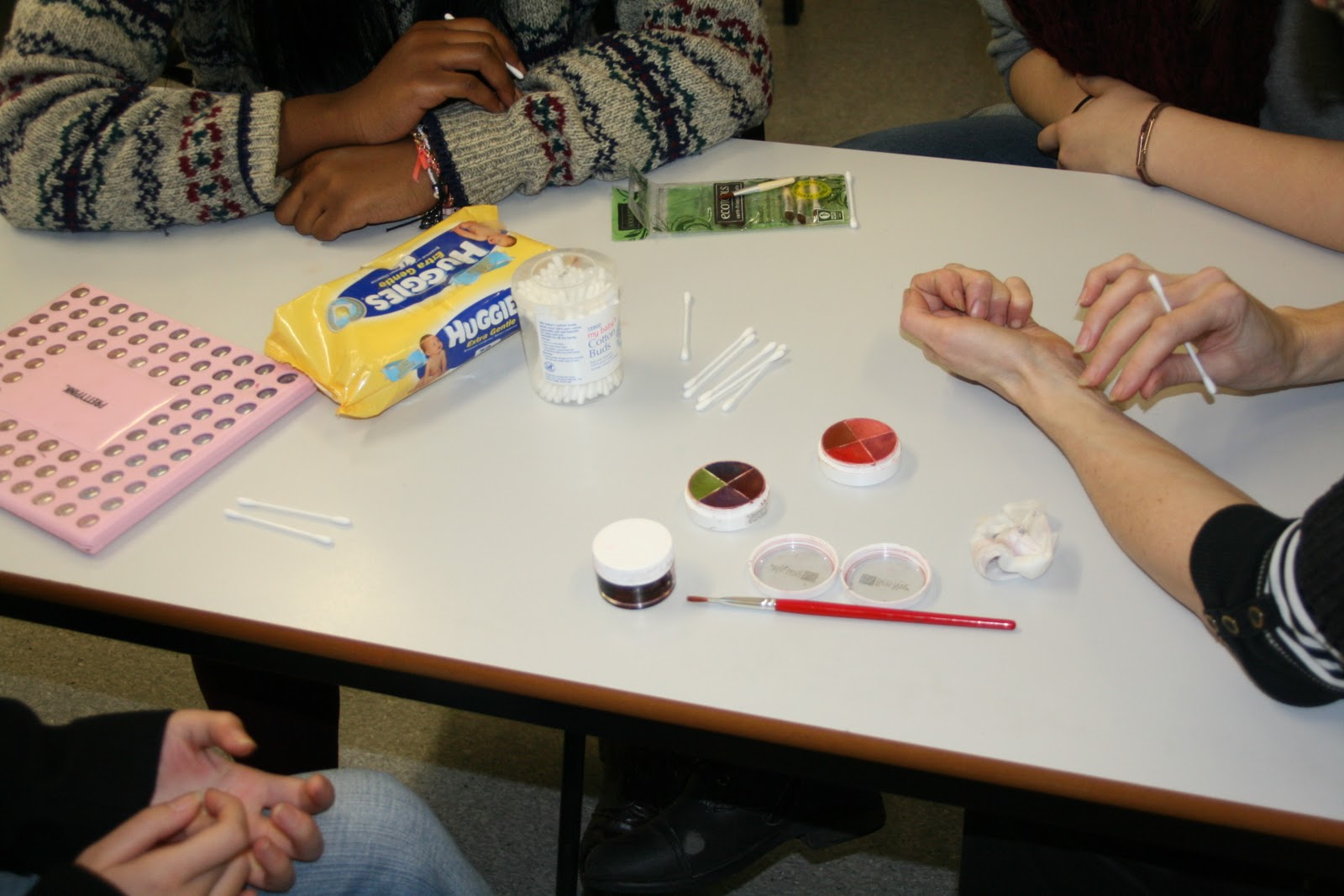
Here on this table is the make up and equipment that we will be using.
This consists of:
 Make up brushes
Eye shadow pallette
Cotton buds
Baby wipes
f/x color wheels - Ck-1Bruises, CK-9 Severe exposure
Fresh scab
Latex


Here is the first colour being applied to the wrist the best wheel to use is the ‘severe exposure’ as it is colours that resemble cuts and new wounds better. A fine brush was used to make it quite thin.
This is the first layer and will give the affect that it has been cut and make it more genuine.


On top of this layer ‘fresh scab’ was applied. This gives the idea that it is/was an open wound and makes it look much more real.

Here are the initial wounds without the final touches.

Then using cotton buds. Around the cut bruises were added lighter colours were use to make it look recent.


Then bruises were made on the arm with a similar colour to look like recent impact wounds.


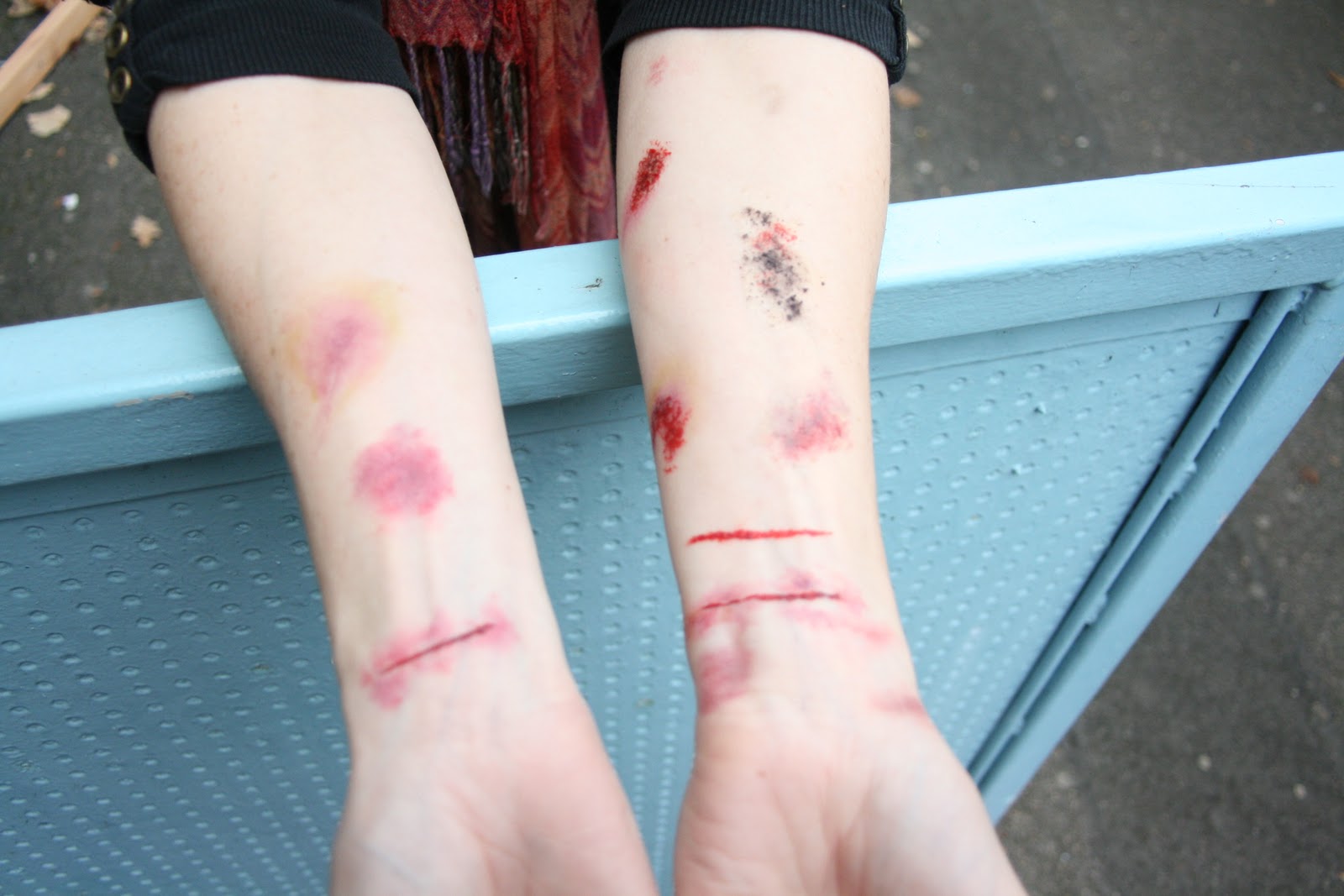
These are the final outcome of the cuts and bruises, as you see we wanted then to look recent which is why we have a lot of reds and fresh cuts. The idea is that she has recently been attacked before she is running through the woods.


We wanted to give the idea that the injury came from the ground in a forest so a dark coloured foundation was crushed and stuck on the bruise or graze with latex, this is so it sticks to the arm and looks real.


This is the final outcome of the make up test.
We went for more recent looking wounds, as in our trailer the victim is going to be recently hurt. Which are common in slashers, like if she has been cut and she is running away.


Here is us using the same technique to create a sliced neck. For extra practice and if we do think about maybe using it.

Friday, 2 December 2011

Research into Lighting - HOALIE

Lighting Types

Lighting is a very important aspect for shaping meaning in films. The lighting technicians in a film crew have the task of creating lighting to suit the mood and atmosphere of each scene in a film. The type of lighting can greatly affect the atmosphere that is trying to be created. There are several kinds of lighting situations. You could have diffuse, non-directional lighting, for example, the light on an overcast day. Another type of lighting is lighting from one direction. A common example of this is the rays from the sun. As the sun is so far away, it can be treated as a point source of light, which is what gives it such a strong directional quality.
Directional light can be split into 3 rough types. These are frontlighting, sidelighting and backlighting. As hinted by the names, frontlighting refers to light coming generally from in front of the subject, while sidelighting is when light comes from the left or right of the subject, and backlighting is where light hits the subject from behind, and goes relatively directly towards the camera. They are not fixed angles; you can have different proportions of two of these happening at the same time.

Frontlighting
This is one of the easier lighting situations to work with. When you have light coming from in front of the subject, they are lit up quite evenly, and the contrast is relatively low. This allows for decent-looking shots from lower quality cameras, where the dynamic range may not be that great. Frontlighting should be quite easy to meter for. Automatic camera modes should be able to handle this situation correctly. One disadvantage of this lighting scenario is that the subject is facing the light, which can cause squinting.

Pros:
  • Provides the most information to the camera by lighting the entire scene.
  • Easiest type of light to deal with photographically because there are fewer shadows to confuse the camera's light meter.
Cons:
  • Can be a bit boring—pictures lack volume and depth.
  • Textures and details are minimized. Scenes appear flat with few shadows.
  • Flash pictures may result in very bright subject areas and very dark backgrounds, if the background is beyond flash range.


Sidelighting
You have sidelighting if the light is coming primarily from the left or right of the subject. If the difference in illumination between the left and right sides is large, then the side in shadow may look a lot darker than how you see it in real life. This is to do with the limited dynamic range of the camera; it cannot capture details in both the bright and dark areas if the difference in brightness is too large. However, the effect you get is a dramatic looking picture.

Pros:
  • Can separate the subject from the background.
  • Conveys depth, as in a landscape at sunset.
  • Conveys texture, as in a weathered tree, fence, or plowed field.
Cons:
  • May be too severe for some subjects, creating some areas that are too bright, and some that are too dark. (See Fill flash to compensate.)


Backlighting
This lighting type is one of the most challenging ones to capture correctly, but is potentially the most beautiful. When you have light coming from behind the subject, you have a very large difference between the brightness levels of the subject and background. If you don't reduce this contrast by adding in light from the front, you'll lose detail in one of them.

Losing detail in the subject will result in a silhouette picture, where the subject becomes a block of dark solid colour. Sacrificing detail in the background is done by overexposing it too keep the subject at a good exposure. This can introduce effects like lens flare and light bleed, which can add to the image if you're trying to convey a warm atmosphere.

Pros:
  • Simplifies a complicated scene by emphasizing the subject, as in a silhouette.
  • Provides a flattering halo of light in portraits.
  • Adds strong shadows in landscapes.
Cons:
  • Lack of detail in a dark subject.
  • Causes lens flare resulting in low contrast and strange light spots across the picture.
  • Using exposure compensation to overcome backlighting results in too-bright background.

Thursday, 1 December 2011

Tester trailer - JASON


Klown tester trailer


This is a video that Jason created with his friends out of college. This was what the final trailer is intended look like but of course to a much more professional standard as this was just a practice shot.Doing this practice shot enabled us to see if our idea really worked as we only talked about it in theory. This allows us to think what is the best angles to work with and what is needed to make our trailer perfect.

Youtube page - JASON


Here is our youtube page to post any videos we do including our main teaser.
Youtube is a very revolutionary website that has helped people post videos to the world.